Celebrating Cultural Exchange: The Fulbright Program at 80 and the United States at 250 – The 1960s
2026 marks a historic year honoring two monumental milestones: the 80th anniversary of the Fulbright Program and the 250th anniversary of the United States. At the same time, it also celebrates more than seven decades of transatlantic partnership through the German-American Fulbright Commission, which has been fostering academic exchange between Germany and the United States since 1952.
The 1960s | Between expansion and upheaval
By the 1960s, the Fulbright Program between the United States and the Federal Republic of Germany had grown from a fragile post-war experiment into a dense network of exchanges. In Washington, policymakers were rethinking the role of education and culture in foreign policy; in Bonn and on German campuses, a new generation was asking difficult questions about democracy, responsibility, and the legacy of the war.
In 1962, the program marked the tenth anniversary of Fulbright Germany, celebrated with a distinguished Fulbright seminar in Bonn. Among the guests and speakers were Senator J. William Fulbright himself and Dr. H. G. Kiesinger, who was serving as President of the German Bundesrat at the time.
In the White House: setting the course
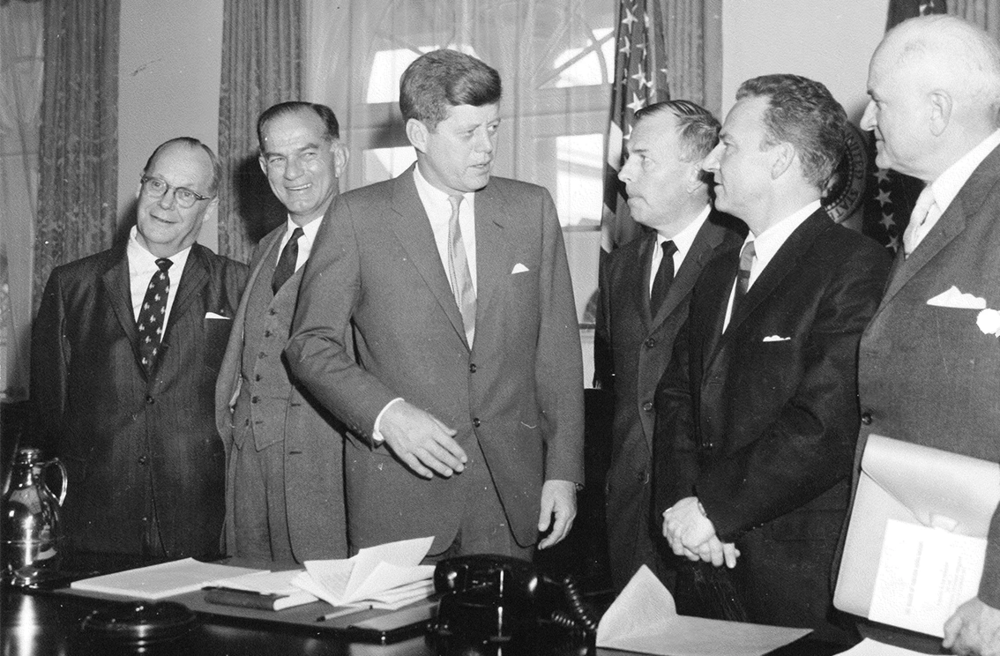
On 27 February 1961, a group of senators, university leaders and government officials gathered in the White House for a joint meeting of the Board of Foreign Scholarships and the U.S. Advisory Commission on Educational Exchange. Among them were J. William Fulbright, author of the original Fulbright Act, and the newly elected John F. Kennedy, who had campaigned on a promise to renew America’s engagement with the world.
The photograph shows them standing around the President’s desk, papers spread out, mid-conversation. Later that same year, Kennedy would sign the Mutual Educational and Cultural Exchange Act of 1961, better known as the Fulbright-Hays Act. The law expanded and reorganised U.S. educational and cultural exchanges, giving them a clearer mandate as part of American foreign relations.
From the outset, the Act explicitly framed programs like Fulbright as tools for "promoting better mutual understanding among the peoples of the world" — a mission that would be tested repeatedly as the decade unfolded.
Teachers on the tarmac: 1968
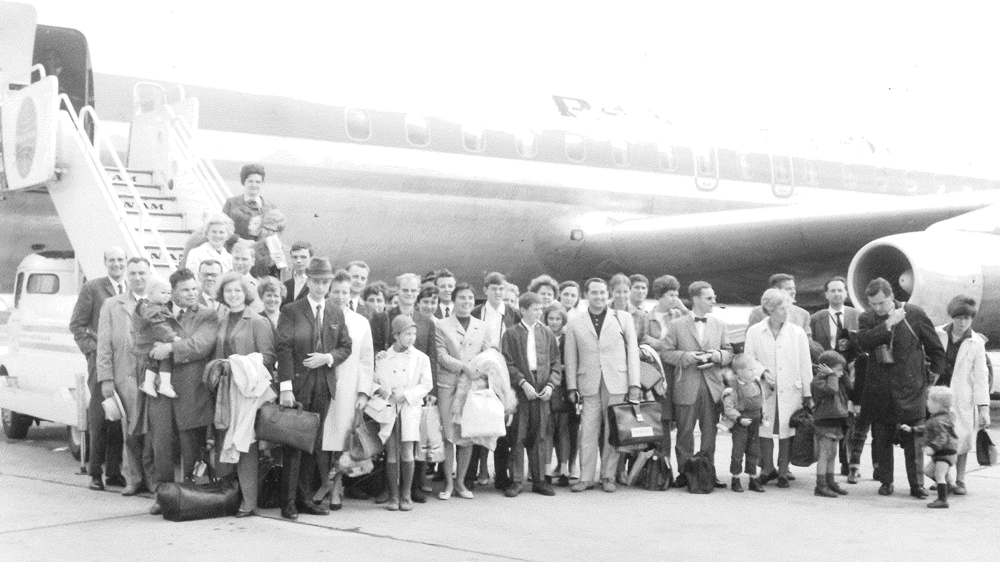
A second photograph, taken seven years later on 16 August 1968, shifts the perspective from the Oval Office to an airport runway. In front of a Pan American World Airways jet, a large group of German teachers pose with their families and luggage just before boarding a flight to the United States. The caption identifies them simply as "German Interchange Teachers"; on the far left stands Ulrich Littmann, then Executive Director of the program.
These teachers were part of a growing effort in the 1960s to extend transatlantic exchange beyond universities and into schools, language classrooms and local communities. Their year in the United States would shape not only their own teaching, but also the pupils and colleagues they met upon their return to Germany.
The timing is striking. In 1968, students in both countries were in the streets: protesting the Vietnam War, demanding a more honest reckoning with the Nazi past, and calling for university reforms. While demonstrations and debates dominated headlines, programs like the Interchange Teachers quietly continued the everyday work of building understanding — lesson by lesson, classroom by classroom.
Parallel journeys: Albert Steven Walleck and Gudrun Monheim
Within this larger landscape, the Fulbright archives preserve the stories of two students born in the same year, 1944, whose paths crossed in the records of the German-American Fulbright Program: Albert Steven Walleck from the United States and Gudrun Monheim from the Federal Republic of Germany.
An American in Bonn
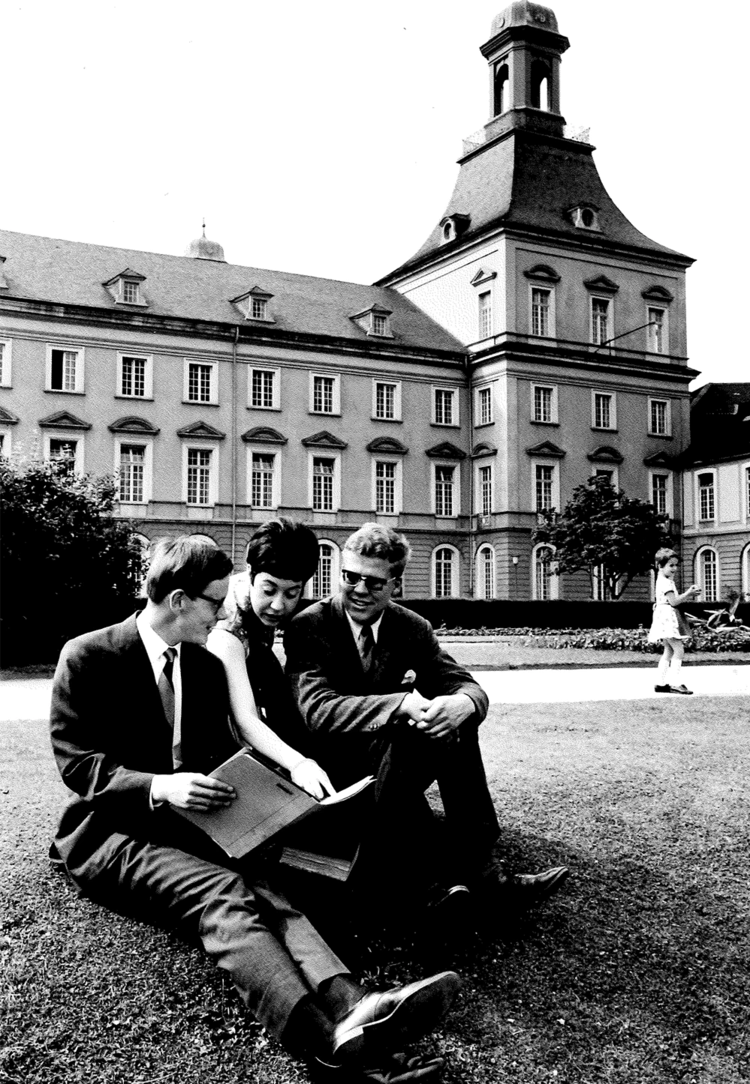
In 1966, Albert Steven Walleck – known as Steven – came to the University of Bonn on a Fulbright grant for the academic year 1966/67. A graduate of Shady Side Academy and Harvard College, he arrived in Bonn at a moment when West German universities were expanding and beginning to feel the first stirrings of the student movement.
Photographs from his year show him in the university library, standing at long rows of wooden card catalogues, carefully sliding out drawers in search of the next book. Other images capture him sitting with fellow students on the lawn in front of Bonn’s baroque main building, or comparing notes outside the library — snapshots of everyday academic life on the eve of profound change.
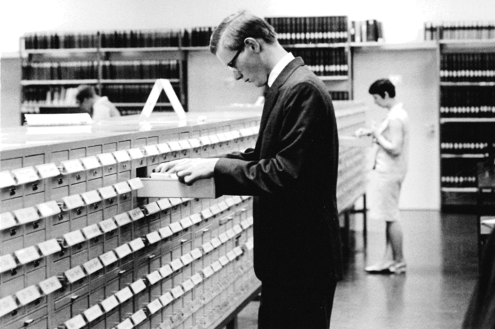
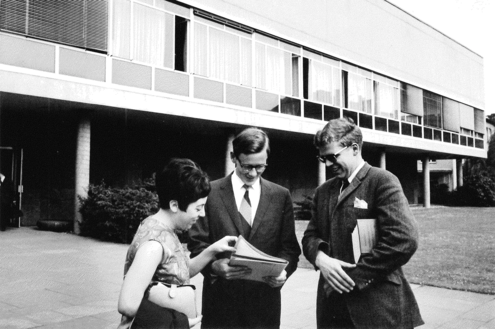
During his Fulbright year, Steven also worked for TIME Magazine. According to his later obituary, this period in Germany helped spark a lifelong fascination with compelling stories and global perspectives. After returning to the United States and completing an MBA at Harvard Business School, he embarked on a 25-year career at McKinsey & Company, later serving as CEO of several firms. His professional life remained deeply international in scope — a trajectory first shaped, in part, by that year in Bonn.
A German student heading west
At almost the same time, the files of the Fulbright Commission in Germany record a young German psychology student: Gudrun Monheim. Born on 6 August 1944 in Ilmenau, Thuringia, she studied psychology at the University of Bonn. In 1966, she received a Fulbright grant to spend a year at the University of Kansas, where she planned to focus on social psychology.
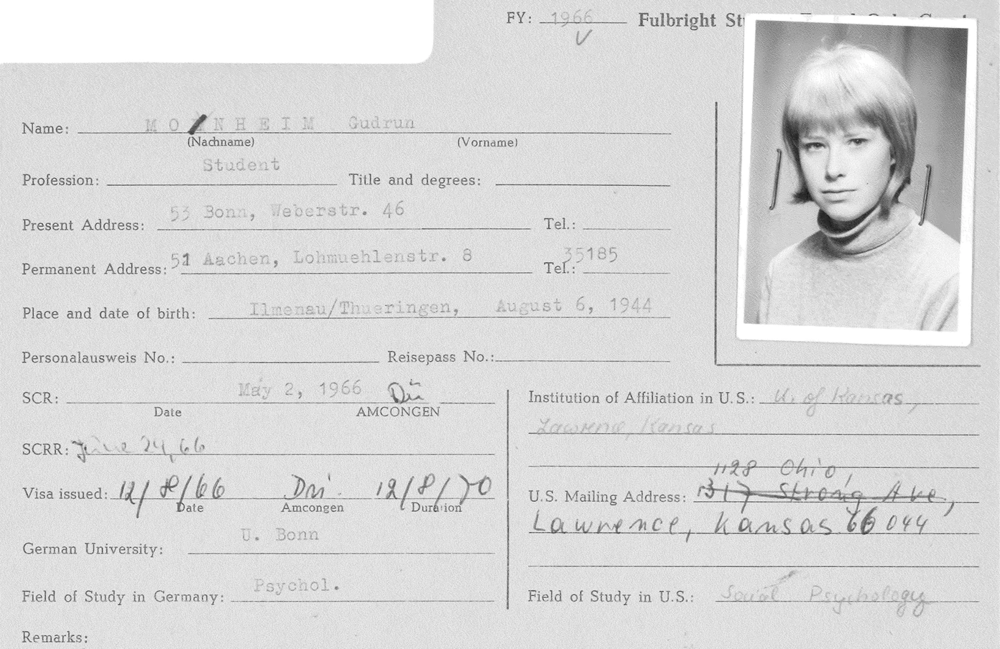
Her file card is precise and understated: addresses in Bonn and Aachen, visa dates, and the field of study. Unlike Steven, we do not yet know how her career unfolded. But even these brief administrative traces tell us that she belonged to a small group of German women who, in the 1960s, took their studies abroad, entering a still-young discipline at a time of intense social and political change.
While Steven was learning to navigate German academic culture and post-war European politics, Gudrun was preparing to experience an American campus in the middle of the civil rights era and the debates surrounding the Vietnam War.
Fulbright at a turning point
Steven and Gudrun’s exchanges took place at what would later be seen as a high-water mark for Fulbright grants. In the 1966/67 academic year, nearly 1,900 awards were given to U.S. citizens going abroad under the Fulbright-Hays framework. Within just three years, however, budget cuts linked to the growing costs of the Vietnam War reduced that number by more than half, to 817 grants worldwide in 1969/70.
Bi-national Fulbright commissions across Europe and beyond expressed deep concern, describing the cuts as a serious blow to programs designed to promote understanding rather than conflict. Seen from this perspective, Steven, Gudrun, and the German Interchange Teachers of 1968 belong to a cohort that benefitted from the expansion of exchanges in the early 1960s and stood just before a period in which such opportunities would become much rarer.
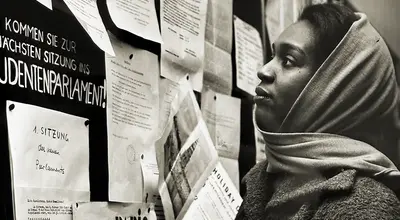
At the other end of the decade, students in West Germany were demonstrating for democracy, confronting the Nazi past of influential figures, and protesting emergency laws they feared might limit civil liberties. Many of those debates unfolded on the same campuses where Fulbright grantees were studying, teaching and living.
Crossing a turbulent decade
The archival record does not tell us whether Albert Steven Walleck and Gudrun Monheim ever met, or whether any of the German Interchange Teachers in the 1968 photograph later crossed paths with Fulbright alumni in the United States. It is easy to imagine, though, that some of them shared lecture halls, staff rooms, or dinner tables; that conversations begun on a Bonn lawn continued in a Kansas seminar room, or that classroom discussions in small American towns were shaped by German teachers who had just lived through 1968.
Together, these images and documents show what the Fulbright Program in the 1960s had become: anchored in high-level policy decisions in Washington and Bonn, carried forward by teachers, students and scholars moving in both directions, and deeply intertwined with a decade marked by protest, reflection and rapid social change.
As Fulbright Germany approaches its 80th anniversary, the stories behind these photographs remind us that the history of academic exchange is written not only in laws and statistics, but in meetings and departures, in teachers on a tarmac, and in individual journeys that cross at just the right moment in time.